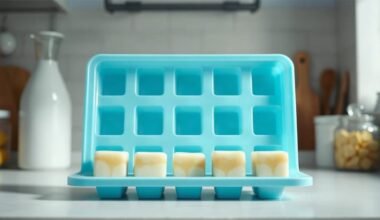

Ice picks up smells because frozen water absorbs odour compounds from the food around it. To stop ice picking up nearby food smells, store strong-smelling food in airtight containers, keep finished cubes in a sealed bag or container, clean the ice bin and trays regularly, and use an odour absorber such as baking soda in the freezer.
That faint whiff of garlic bread in your glass of water is not your imagination. Ice left in the freezer slowly absorbs odours from whatever surrounds it, and because water has almost no flavour of its own, it takes very little to change how it tastes. The good news is that the fix is usually cheap, quick and mostly about storage habits.
Key takeaways
- Ice picks up smells: as it sits in the freezer, it absorbs odour compounds from nearby food, which is why old cubes often taste like the freezer rather than like water.
- Check the obvious first: uncovered garlic, onions, seafood and leftovers near the ice are the most common culprits, so remove the source before blaming your appliance.
- Seal everything: airtight containers for smelly food, and airtight storage for finished ice, solve most problems on their own.
- Clean the ice-contact parts: bins, trays, scoops and chutes hold residue that keeps flavouring fresh cubes even after the smelly food is gone.
- Refresh your stock: discard old ice and make a new batch once the freezer is clean and sealed, because odour alone does not mean the ice is unsafe, just unpleasant.
Why does ice absorb smells from the freezer?
Water does not have much flavour on its own, which means it does not take much to change it. As ice sits in your freezer, it slowly absorbs odour compounds released by nearby foods. Garlic, onions, seafood, frozen leftovers and other strongly scented foods all contribute to what people describe as “freezer taste”, and the same reason explains why ice left uncovered for weeks rarely tastes as fresh as a new batch.
Your freezer might look clean, but if it smells like anything at all, your ice is probably noticing. The longer cubes sit, the more freezer smells they can pick up. The longer cubes sit, the more they pick up.
Why does my ice smell like garlic or onions?
Nearby strong-smelling or leaking food is the most practical first explanation. Uncovered garlic, onions, leftovers, or containers that have leaked and left a sticky film on a shelf or wall can all be enough to taint every cube in the freezer, according to Euhomy’s guide to smelly ice.
There is a second possibility worth knowing about. Many fridges have a single evaporator, which means air moves between the fresh-food and freezer compartments and carries odours with it. Consumer Reports famously filled the fresh-food compartment of a single-evaporator fridge with garlic, made ice in the freezer, and found the ice did not just smell like garlic, it tasted like it too. If your freezer itself smells neutral but the ice still tastes odd, look at the bin, tray, scoop or ice-maker interior rather than the food around it.
How to stop ice picking up nearby food smells: step by step
Work through this list in order. Most people find their problem is solved by step one or two.
- Remove the source. Take out anything uncovered and strongly scented, and bin anything that has leaked, spoiled or left a sticky residue.
- Discard the affected ice. Empty your trays and ice bin, then wash them in warm soapy water and dry fully before refilling.
- Wipe down the freezer. Clean shelves, walls and corners where residue can linger, including the ice chute and door seals if you have an ice maker. Follow your owner’s manual for cleaning accessible parts.
- Store smelly food properly. Use airtight containers for garlic, onions, fish and leftovers, and wrap anything pungent tightly.
- Store your ice properly too. Move finished cubes into an airtight, sealed container or freezer bag so they have nothing to absorb.
- Add an odour absorber. An open box of baking soda or a piece of activated charcoal near the back of the freezer will absorb stray smells.
- Make a fresh batch. Once everything is clean and sealed, freeze a new batch and taste the difference.
Should I throw away ice that smells like food?
Yes, it is worth doing, though not for safety reasons. Odour alone does not prove contamination, as Euhomy’s guidance points out. Ice that smells like onion is almost certainly unpleasant rather than dangerous, but there is no reason to drink around it. Tip it out, clean the container and freeze fresh cubes. Old cubes that have been sitting for weeks or months are also simply past their best, so clearing them out is part of the reset.
If you use trays, there is a good chance some cubes have been sitting in the freezer far longer than you think. Automatic ice makers cycle cubes constantly, but tray ice can linger indefinitely, quietly collecting freezer flavour along the way.
How should I store ice cubes in the freezer?
The simplest and most effective habit is to transfer finished cubes into an airtight container or sealed freezer bag as soon as they are frozen. This gives the ice a barrier between it and everything else in the freezer, and it also frees your trays up for the next batch. If you have ever struggled to release stubborn cubes, our guide to why cubes stick in a silicone mould covers how to get them out cleanly before decanting.
Keep the container away from open smelly food where possible, and top it up as you go. Rotating your stock, using the oldest cubes first, means nothing sits long enough to pick up much flavour at all.
What freezer habits keep ice tasting fresh?
- Temperature: keep the freezer at a steady temperature around 0°F (-18°C). A stable, cold freezer reduces moisture and odour transfer, and keeps food properly frozen.
- Ventilation: avoid overcrowding the freezer and defrost when needed. Good airflow means less stale air and fewer odours clinging to surfaces, including your ice.
- Regular cleaning: wipe spills promptly and give the freezer a proper clean every few months. Consumer Reports recommends cleaning the ice collection bin according to the manufacturer’s instructions to avoid smelly cubes.
- Odour absorbers: baking soda or activated charcoal placed near the back of the freezer quietly absorbs stray smells between cleans.
- Airtight everything: the more sealed your food is, the less odour is circulating in the first place.
Why does my ice still smell after I cleaned the freezer?
If the freezer smells neutral but the ice is still off, the problem is usually in the parts the ice actually touches. The ice bin, tray, scoop, chute, seals and corners can all hold residue that keeps flavouring fresh cubes, so clean each of these according to your owner’s manual before investigating anything else.
If that does not fix it, the next thing to consider is the water filter on fridges with built-in ice makers, followed by the appliance itself. And if you are shopping for a new fridge anyway, it is worth knowing that Consumer Reports suggests considering a dual-evaporator model, where the fresh-food and freezer compartments have their own dedicated evaporators and no air passes between the two spaces, which can help avoid smelly ice, though these models tend to cost more than single-evaporator designs.
Does the tray material matter for smelly ice?
Indirectly, yes. Ice-contact parts such as bins, trays and scoops can hold residue from spilled or spoiled food, which is why cleaning them according to the owner’s manual matters. If you are replacing old equipment, look for trays described as food-safe and BPA-free; our explainer on BPA-free and food-safe labels breaks down what those terms actually mean. Whatever material you choose, look for trays described as food-safe and give them a good wash and full dry before refilling.
Whatever material you choose, the golden rule is the same: clean, dry and covered beats leaving open trays at the mercy of a garlicky freezer.
FAQ
How long does it take for ice to absorb freezer smells?
It happens gradually, which is why freshly made ice tastes better than cubes that have sat for weeks. There is no fixed timeline, but the stronger the smells and the more open your ice is, the faster it will pick up flavour. Sealed storage stops the process almost entirely.
Can smelly ice make you ill?
Odour alone does not prove contamination. Ice that smells like onion or freezer is usually unpleasant rather than harmful, but if the ice came into contact with spoiled or leaking food, discard it and clean the area before making more.
Does baking soda really keep the freezer smelling fresh?
Baking soda and activated charcoal both absorb odours, and either placed near the back of the freezer helps reduce the smells circulating around your ice.
Should I empty my ice maker bin regularly even if I do not notice smells?
Yes, it is a good habit. Washing the bin, scoop and chute now and then, following your manufacturer’s instructions, prevents residue building up and keeps cubes tasting fresh even when nothing smells obviously wrong.
Why does ice from my fridge taste worse than ice from trays?
Built-in ice makers share air with the fridge compartment on many single-evaporator models, so fridge odours travel into the freezer and the ice. Keeping the fridge clean and food covered helps, and a dual-evaporator fridge avoids the problem altogether.
Final thoughts
Ice should taste like nothing at all, and keeping it that way comes down to three habits: seal the smelly food, seal the finished ice, and clean the parts ice touches now and then. A box of baking soda and a decent airtight container will cover most of it. When you are ready for a fresh batch, a good set of trays makes it easy, and if you are freezing in bulk, our guide to portioning baby food with ice trays shows how versatile they are beyond the drinks cabinet.