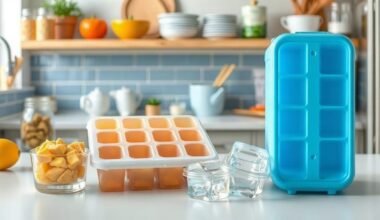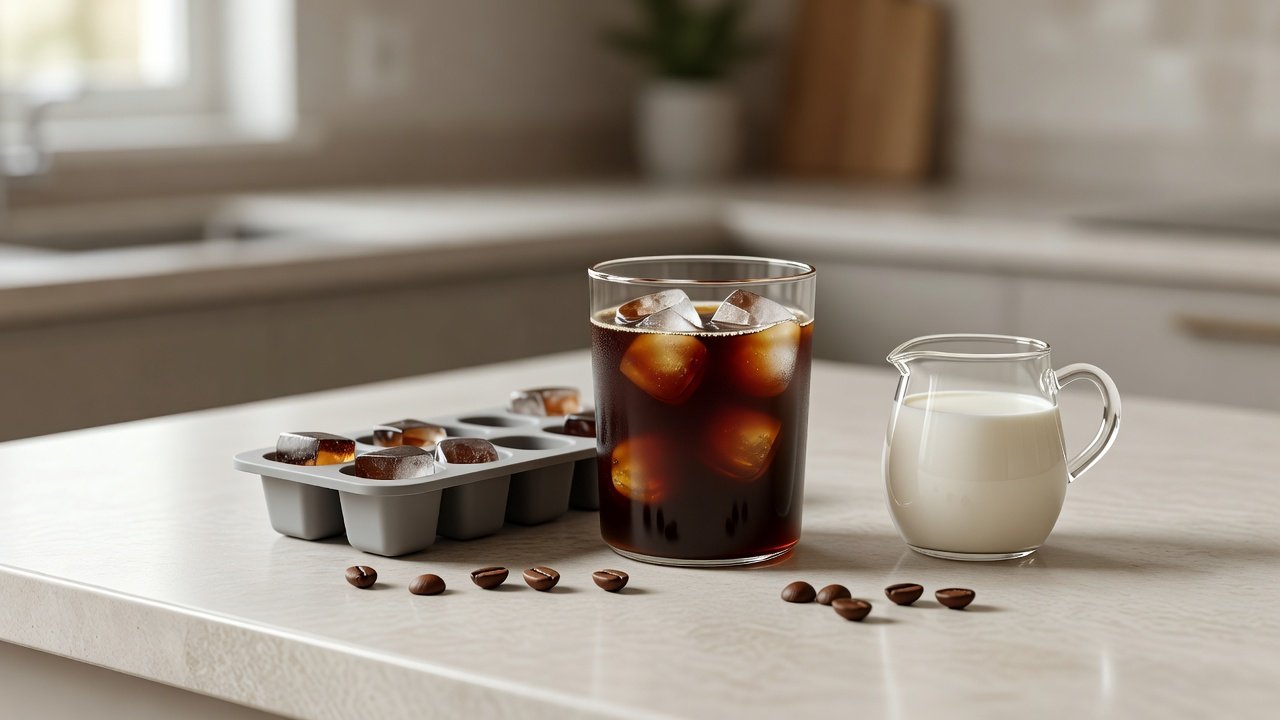

Short answer: Coffee ice cubes are brewed coffee frozen in a tray, so the melt is coffee rather than water. Freeze milk on its own, or mix cooled coffee with milk, when the drink will be milky. Brew at least as strong as you want the finished glass, cover the tray, freeze until the centre is solid, and keep the cubes in a labelled bag.
In this guide
- Why iced coffee turns watery
- What to freeze
- Ratios for a stronger glass
- How to make coffee ice cubes
- Choosing a tray
- Freezing times
- Storing coffee ice cubes
- Building the drink
- Cold brew cubes
- Mistakes to avoid
- FAQ
Why iced coffee turns watery
Ordinary ice is frozen water. It cools the glass, then turns back into water with no coffee in it. Early sips taste right. Give it a little time, especially in a warm kitchen, and the top of the drink tastes thin.
The coffee is seldom the real fault. The ice was the wrong liquid.
Coffee ice cubes melt too, but the liquid they add is coffee. The glass gains some volume as they shrink, and a very long sit will taste a little flatter, because cold quiets aroma. It should not fade into tap water. In a milky drink, milk cubes do the same job: what melts is milk, not a puddle from the tap.
Nothing in the tray can rescue a weak brew. Thin coffee in, thin cubes out. Put the strength in before you freeze.
What to freeze
Black coffee cubes
Use these for straight iced coffee. Cool a filter brew, a cafetière, espresso or cold brew, then freeze it. The cube can only taste of what you poured, so start with coffee you would happily drink hot.
Milk cubes
Freeze dairy milk, or a plant drink you already like, in its own tray. Cow’s milk, oat, almond and soya all freeze. Fats and small particles often separate, so the cube may look mottled. That is a texture change, and it is normal. Once it melts, you are drinking the milk you started with.
Mixed cubes
Mixed cubes suit anyone who always wants the same balance of coffee and milk. Cool the coffee, stir in the milk, and freeze the mix. One bag then makes one kind of glass.
Skip cream in the tray. Very fatty liquids tend to freeze grainy and slightly split. A small splash of fresh cream in the glass usually tastes cleaner.
Do not freeze milky coffee that has stood on the side. If you cannot freeze plain coffee at once, cool it and put the jug in the fridge.
The Food Standards Agency chilling guidance says the fridge should be at 5°C or below so food stays properly cold. Use that for any brew waiting to be frozen, and for milk before it is poured. Black coffee cubes are the simpler job. For milk and mixed cubes, freeze promptly and keep them frozen until they go into the glass.
Ratios for a stronger glass
Tray wells are not one standard size. Some hold about a tablespoon, others hold far more, so think in proportions rather than a fixed number of cubes. Taste is personal. Treat every figure below as a starting point you can change next time.
If you drink the coffee black, freeze a brew you already enjoy. Pushing it much stronger only makes a harsh cube.
Brew a little stronger when milk will go into the glass, so the milk does not erase the coffee. A useful start is about 1.25 to 1.5 times your usual amount of grounds, with the same water as a normal cup. If that cube tastes bitter, use less coffee next time.
Espresso cubes are concentrated already. A home double shot is a small pour and may fill only two to four small wells, depending on the tray. Do not water the shot down just to use every cavity unless you want a milder cube.
Taste a mixed batch before it freezes. About two parts cooled coffee to one part milk leans towards coffee. Equal parts is softer. Neither ratio is mandatory.
Stir sugar into the coffee while it is still warm, until every granule has gone. Or add syrup in the glass later. Dry sugar in a cold drink mostly sits at the bottom.
Build the glass from the same idea. For black iced coffee, fill about half to two thirds with coffee cubes and top up with chilled coffee or cold brew. For a coffee-led milky drink, use coffee cubes for about a third to a half, then cold milk. For a milk-led drink, start with milk cubes and a short pour of cold, strong coffee.
Leave ordinary water ice out when you want the cup to stay strong. It drops the temperature a little faster, and it also dilutes the drink.
| Drink | Cubes to freeze | What to pour on top | Starting point |
|---|---|---|---|
| Black iced coffee | Black coffee or cold brew | Chilled coffee or cold brew | Cubes about half to two thirds of the glass |
| Milky, coffee-led | Black coffee brewed a little stronger | Cold milk | Cubes about a third to a half of the glass |
| Milk-led | Milk | Cold strong coffee | Enough cubes to chill the glass, then taste |
| One-bag latte style | Coffee and milk frozen together | A splash more cold milk or coffee if you want | Cubes about half the glass, then adjust |
How to make coffee ice cubes
- Brew into a clean jug. Plain leftover coffee is usable if it was cooled, refrigerated promptly and never had milk in it.
- Let the coffee cool before it goes near the tray. Hot liquid can distort some plastic trays. A warm tray also makes the freezer work harder and can soften food beside it.
- Sweeten at this stage if you want sweet cubes, and stir until nothing gritty remains.
- Add milk only for mixed cubes, and only once the coffee is cool.
- Set the tray flat. Fill each well and leave a small gap under the rim. Coffee is mostly water, and water expands as it freezes. A brim-full tray spills, sticks to the shelf and welds the cubes together.
- Put the lid on. If there is no lid, lay a clean sheet of baking parchment over the tray so other smells stay out.
- Freeze until the centre of a cube is solid, not just the shell.
- Flex a silicone tray to release the cubes. For rigid plastic, run cool water over the back for a few seconds. Do not prise stuck cubes out with a knife.
- Tip them into a labelled bag or box and return them to the freezer before they sweat and clump.
- Wash the tray between uses. Coffee oil lingers, and a stale smell will flavour the next batch.
Choosing a tray
Well size changes the drink more than the name on the packet.
Small cubes chill fast and melt fast. They fit narrow glasses and drinks you will finish quickly. In a warm room they disappear fast. The melt is still coffee, but you will be refilling sooner, and a short drink can lose its ice before you are ready.
Large cubes melt more slowly. One or two can hold a tumbler without flooding it. They need more time in the freezer, and they chill the first sip less if the coffee you pour is not already cold. Shapes and capacities for that slower melt are compared in the 5 Best Large Ice Trays for Iced Coffee & Premium Drinks.
A lid earns its place. Ice left open takes on the freezer. Coffee is aromatic, but it will not cover the smell of pungent food a shelf away. A cover also limits spills when a shelf is nudged.
Silicone lets cubes out with a bend. Wash it in hot water with washing-up liquid and dry it in the air, or it keeps a coffee smell and a brown tint. Rigid plastic stacks easily. Twist frozen trays gently so thin plastic does not crack. Light-coloured plastic shows coffee staining. The mark is cosmetic, and a soak often fades it.
A novelty mould is optional. Spheres melt relatively slowly and sit neatly in a glass, yet a plain covered tray you will actually refill is what keeps a weekday iced coffee from going watery. For cold brew, the useful points are the lid, the well size and how cleanly the cubes release. Those are set out in the 5 Best Iced Coffee Ice Trays for Cold Brew (2026).
Freezing times
Many home freezers are set around minus 18°C. A warmer dial, a packed cabinet or coffee that went in while still warm will all add time. Read the ranges as typical, not as a fixed clock. Your freezer and your tray decide the result.
Small cubes are often solid in about 3 to 4 hours. Standard cubes often take about 4 to 6 hours. Large cubes often need 6 hours, and an overnight freeze is the reliable plan.
A milk mix can firm on top while the core stays soft. Use the longer end of the range. If a cube still gives under a fingertip, leave it. Soft centres leak in the bag and then freeze into a brick.
When you are unsure, wait until morning. There is no benefit in bagging a cube that is only half set. Do not sit a second wet tray on an open first tray, or the two can freeze into one piece.
| Cube size | Typical time around minus 18°C | What to expect in the glass |
|---|---|---|
| Small | About 3 to 4 hours | Chills quickly and melts sooner |
| Standard | About 4 to 6 hours | A practical everyday size |
| Large | About 6 hours, or overnight | Slower melt, better for a longer drink |
Storing coffee ice cubes
The open tray is for freezing, not for keeping. Once the cubes are hard, move them to a freezer bag with the air pushed out, or to a box with a lid. Write the contents and the date on the outside. Black coffee, sweetened coffee and oat milk look the same when they are frozen, and they do not taste the same.
Plain coffee cubes, kept frozen, are a flavour question first. They usually taste clearest within about a month. Later they can taste flat or slightly of the freezer. Some households keep them longer and still enjoy them. That is a judgement of taste, not a published standard. Bin any cube that smells wrong or has dried, grey edges.
Milk and mixed cubes are a shorter store. Mottling from separated fat or oat solids is common. Try to use them within about two to four weeks, and do not thaw them on the side and freeze them again. Those spans are home guidance for quality. They are not a formal expiry date.
Shut the bag each time. Moist kitchen air frosts the surfaces and makes the cubes stick. A stuck mass is annoying, and prising it apart on the worktop starts a melt you did not want.
Building the drink
Cool the glass if the room is warm. Add the cubes, pour fridge-cold coffee, cold brew or cold milk over them, stir once and drink. A strong iced coffee is mostly cold coffee plus coffee ice, not a short pour lost in a pint of milk and water ice.
Sweeten with syrup, or with coffee that was sweetened while it was hot. A teaspoon of dry sugar will not dissolve properly in the cold glass. If you like a vanilla or cinnamon note, it belongs in the tray, not as a dusting that sits on the ice.
Hot espresso over one small cube undoes the method. The cube disappears and the shot is lukewarm, which is the watery problem in a new form. Cool the espresso first, or pour it onto enough coffee cubes to take the heat, and accept some immediate melt.
Fridge-cold coffee already has its chill. The cubes then exist to stop dilution, which is why you made them. You need fewer of them to make the first sip feel cold, and more of them if the glass will sit for a while.
Drink a milk-based glass in one sitting. The warm dregs from the table should not be frozen into the next batch. Brew fresh coffee for the next tray.
Cold brew cubes
Cold brew can go straight into the tray because it is already cold. Many people also find it smoother than hot coffee that was cooled later, so the cubes often taste rounder. It is a good way to use a jug you will not finish within a few days.
Match the cube to the job. Everyday cold brew, frozen as you drink it, gives cubes that taste like the jug. A concentrate is the more useful freeze when the cube has to cope with a lot of milk.
Home ratios vary, so treat these as common ranges rather than a rule. Concentrate is often about one part coffee to four or five parts water by weight. Ready-to-drink cold brew is often nearer one part coffee to eight parts water, sometimes weaker. When a jar tastes right, note the coffee and the water and repeat it. Steeping in the fridge for about 12 to 24 hours is a usual home span. A much longer steep can taste woody, and freezing will not correct that.
Strain the brew. Fine grounds become grit in the cube. A paper filter or a fine mesh is enough. Grounds left in the tray also make the ice cloudy and slightly silty on the tongue.
Keep milk out of the cold brew jar. Freeze milk cubes beside the coffee, not inside it. Store the black brew covered, in the fridge at 5°C or below, in line with the Food Standards Agency chilling guidance, rather than leaving it on the worktop. Add milk in the glass, where you can taste the balance.
Start with one or two concentrate cubes in cold milk, then taste. Another cube is easy to add. A melted cube cannot be taken back. Skip water ice if the last mouthful should still taste like the cold brew you made.
Mistakes to avoid
The watery taste usually comes back for an ordinary reason, not because coffee ice “does not work”.
- The brew you froze was weak or stale, so the cubes had nothing to give.
- A few cubes went into a very large, very milky glass.
- Water ice was added beside the coffee ice.
- The tray was left uncovered and the cubes taste of the freezer.
- Wells were filled to the rim, so the batch fused to the shelf.
- Hot coffee went into a thin plastic tray, or over a single cube.
- Milky coffee that had sat out was frozen anyway.
- Bags were not labelled, so sweetened oat cubes and black coffee got mixed.
Correct the liquid, cover the tray, allow enough time for large cubes and keep water ice out of the glass. That is most of the method. Two trays a week, one black and one milk or mixed, is enough for many home drinkers, as long as you cool the extra coffee while you drink the hot cup and freeze it the same day.
FAQ
Can I freeze leftover coffee?
Yes, when it is plain coffee that was cooled and refrigerated promptly. Morning filter or cafetière coffee can fill a tray for later. Do not freeze a brew that has sat warm for hours, and do not freeze leftovers that already contain milk.
Will coffee ice cubes taste bitter?
They taste like the coffee you froze, served cold. Cold can make bitterness clearer and aroma quieter. If a batch is harsh, brew a little weaker next time, or freeze cold brew, which many people find smoother. Freezing does not remove bitterness that was already in the jug.
Can I freeze milk and oat milk?
Yes. Dairy milk and oat, almond or soya drinks can go into a clean tray. Expect some separation and a mottled look. The melt is still that milk. Keep the cubes frozen and try to use them within a few weeks. Add cream fresh rather than freezing it.
How long do coffee ice cubes keep?
Covered and frozen, black coffee cubes usually taste clearest within about a month. Milk and mixed cubes are better used within about two to four weeks. These are quality ranges for home use, not official dates. Discard any cube that smells off or looks badly dried.
Should I use water ice as well?
Not if you want a strong cup. Water ice chills quickly and melts into water, which undoes the point of coffee cubes. Use it only when you are content for the glass to get weaker as you drink.
Can I add sugar or flavourings?
Yes. Dissolve sugar in the warm coffee, or stir in a little syrup, vanilla or cocoa before freezing, and taste the liquid first. Every cube will carry that flavour, so go lightly. Dry sugar will not dissolve properly once the cube is frozen.
Sources
- Food Standards Agency, Chilling. Cited for keeping the fridge at 5°C or below when cooling coffee before freezing and when storing milk or cold brew.