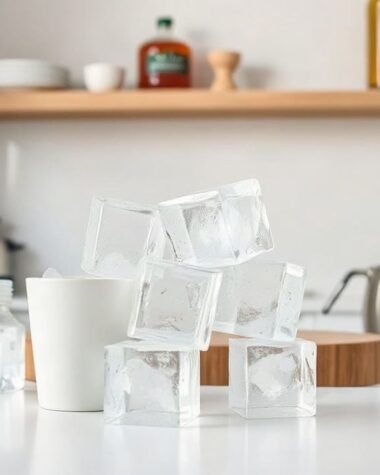
Large ice cubes vs small: the science of melting is surface area. A large cube melts more slowly because less of its ice meets the warm drink or the air at once. Small cubes, shards and crushed ice chill a drink faster, and they add water sooner.
Key takeaways
- A larger cube has a lower surface-area-to-volume ratio, so heat reaches less ice at once.
- Small, crushed or irregular pieces melt faster and soften flavour sooner.
- Denser ice with fewer air pockets resists melting better than ice full of bubbles.
- A warm drink, stirring or a cracked cube can undo the benefit of size.
- Choose large, regular ice for a slow sip, and smaller ice for a fast chill.
Large ice cubes vs small: the science of melting
Ice melts when it absorbs heat and turns from solid to liquid. That heat enters through the outside of the piece. In Ice Presses and Large Cubes: Why Surface Area Matters, Drunken Speculation explains that larger cubes slow melting because less surface meets warm air or water.
A small cube is not a different temperature to start with if both pieces froze together. It has more outside relative to the ice inside it, so the drink can pass heat to more of the ice at once. Extra melt water softens flavour and aroma, and the ice loses its shape sooner. The same guide notes that a properly shaped large cube keeps flavour, aroma and presentation for longer by slowing the melt, and that larger cubes stay colder longer.
Why does surface area decide how fast ice melts?
Every face, edge and thin point is a way in for heat. More ways in means more water in the glass. Drunken Speculation states that a larger cube has a lower surface-area-to-volume ratio, which slows melting and reduces dilution. More surface does the opposite: more ice meets the heat, so melting speeds up.
A neat cube has six faces. Crack or crush it and you add faces and thin edges. The source says irregular or fragmented shapes increase surface area and melt faster. A large cube that splits in the glass starts to act like the small ice you meant to avoid.
The inside of the cube matters too. Denser ice with fewer air pockets melts more slowly, the source says, because it resists heat better. Cloudy ice often holds tiny bubbles that scatter light. Those pockets are gaps, not stored cold, and fewer of them go with a slower melt.
How much extra surface do small cubes add?
You can see the gap with a ruler. The sums below are geometry, not a timed test, so they do not predict an exact minute count in your glass.
A cube with 2 centimetre sides holds 8 cubic centimetres. Six faces of 4 square centimetres give 24 square centimetres of surface. Surface divided by volume is 3 per centimetre.
A cube with 4 centimetre sides holds 64 cubic centimetres. Six faces of 16 square centimetres give 96 square centimetres of surface. Surface divided by volume is 1.5 per centimetre, half the ratio of the small cube.
Eight small cubes hold the same 64 cubic centimetres as one large cube, but their surface is 192 square centimetres against 96. The same ice presents twice the surface. Twice the surface does not mean the ice lasts half as long, because the drink cools as it melts and the glass picks up room heat, yet less exposed surface still means a slower melt and less dilution.
Which ice should you choose for the drink?
For a slow sip
Choose one large, regular cube when you want the drink cold with less melt water. A spirit on its own, or a short mixed drink over a single cube, is the usual case. The ice still chills. It gives up water more slowly, so flavour stays closer to what you poured. That is the practical reading of the surface-area point from Drunken Speculation. The drink can still change as time passes.
For a fast chill
Choose smaller cubes or crushed ice when temperature should drop quickly. A long mixed drink or iced coffee, finished promptly, often suits that. Expect more water. Some drinks are built to open up with a little dilution, so small ice is a choice, not an error.
A few matches
- Use one intact large cube rather than cracked chunks if you want less water in the glass.
- Cover the ice with the drink. Ice in the air still meets warmth, which the source treats as another route for melting.
- If you want a known amount of dilution, add a splash yourself instead of hoping a pile of small ice will stop at the right moment.
How do you freeze ice that melts more slowly?
Pick a mould with one large, even cavity rather than a thin sheet of cubes that snap. A regular block keeps surface down. Silicone is common for big cubes, and a very cold mould can grip them. For a clean release, read Why Cubes Stick in a Silicone Mould (and How to Stop It).
Freeze the cube until the centre is solid. A soft middle breaks, and broken ice melts faster. Some makers try boiling and cooling the water first, hoping for fewer air pockets, though results vary; denser ice with fewer air pockets does melt more slowly. That fits the note on denser ice. It will not make every cube identical, and a genuinely larger shape still changes surface area more.
Keep ice in a lidded box or a closed bag. Open cubes shrink and pit because a frost-free freezer strips moisture, including from the ice. Why that happens is covered in Why Ice Cubes Shrink in the Freezer Over Time (and What to Do About It). A pitted cube has extra surface, so it melts faster than the smooth one you made.
Why does a large cube sometimes vanish quickly?
Size helps only while the piece stays large and whole.
- A warm glass loads heat straight into the ice.
- Stirring and shaking refresh the warm liquid against the cube. Do that for a fast chill, not when you want the ice to linger.
- Sun, a hot room or a place near the oven warms the drink while the ice works.
- Cracking the cube to fit the glass, or resting it on crushed ice, puts the lost surface straight back.
- Dried, cracked or shrunk ice from an open tray already acts like smaller ice. Freeze nearer to use, and keep it covered.
If the cube is gone in a few minutes, check the drink temperature and whether it broke. Melt rate also depends on surface area, ice shape and how whole the piece stays.
A quick comparison table for the home bar
If you keep just two moulds in the freezer drawer, this at-a-glance guide helps you match the ice to the drink. Figures are general serving habits, not laboratory results, so treat them as friendly rules of thumb rather than precise numbers.
| Ice style | Best suited to | Why it works |
|---|---|---|
| Large cube (around 5 cm) | Spirits over ice, negronis, old fashioneds | Slow melt protects the balance of a strong pour |
| Medium cube (around 2–3 cm) | Highballs, iced coffee, fruit cordials | Chills quickly yet holds its shape through a longer drink |
| Crushed or nugget ice | Mint juleps, tiki cocktails, smoothies | Maximum surface area for fast chilling and frosty texture |
| Long spear or rod | Collins glasses, tall mixed drinks | Chills along the length of the glass with modest dilution |
A worked example: the same whisky, two glasses
Imagine pouring a 50 ml measure of whisky into two identical tumblers. Glass one gets a single large cube; glass two gets the same weight of ice as small scattered cubes. In either glass, plenty of icy surface meets the drink, so both chill quickly. The difference appears over the next twenty minutes: the large cube exposes less ice to the warming liquid, so it surrenders its water gradually, while the small cubes, with more surface area exposed to the warming liquid, melt and dilute the drink faster. If you sip slowly and enjoy watching the spirit open up, the large cube suits you; if you drink briskly, either choice works. The practical tip is simple: match the melt rate of your ice to the pace of your evening.
FAQ
Do large ice cubes always melt more slowly than small ones?
They tend to, when the large cube stays whole and you compare the same amount of ice. Less surface for that volume gives heat fewer places to enter. A cracked, hollow or very bubbly cube, or ice in a much hotter drink, can still go quickly. Size is the main factor, not the only one.
Will a big cube stop a drink tasting watery?
It slows the water ice adds. It does not stop melting. Any ice in a drink above freezing point will take heat and become water. For less dilution, use one large regular cube. For no melt water, chill the bottle or the glass and skip the ice.
Is crushed ice a bad choice?
No. It melts faster because of the extra surface, which is why it chills so quickly. Use it when the drink will be finished soon and extra water is fine. Use a large cube when you want to sip and keep the flavour steadier.
Does cloudy ice melt faster than clear ice?
Cloudy ice usually holds trapped air and minerals. The source links denser ice and fewer air pockets with a slower melt. Clearer ice is worth a try. Switching from many small cubes to one large cube still changes exposed surface more than clarity alone.
Can the same moulds be used for food?
Yes. A set cavity is a portion tool, not only a drinks tool. Freezing Herbs in Olive Oil Cubes: A Simple How-To Guide uses oil and herbs instead of water for the glass. Keep those cubes away from drink ice so flavours stay separate.
Use the size that matches the glass
Large, solid, regular ice fits when flavour and a slow melt matter. Smaller cubes and crushed ice fit when you want a fast chill and accept more water. Freeze it through, release it cleanly and keep it covered.
Next time you pour, measure your moulds as in the 4 centimetre example. Compare one large cavity with the small cubes that hold the same volume, and use the extra surface to decide which tray to pick.
Sources
Drunken Speculation, Ice Presses and Large Cubes: Why Surface Area Matters.